Have you ever asked yourself or been asked “Why don’t you just …..?” or “How come you are (not) …..?” about studying? Do you ever feel frustrated with yourself due to a lack of results? Sometimes, you are 100% on the task, and yet nothing happens, as if you were not motivated. Sometimes, you work hard, and for some reason or another, you don’t seem to get it right, and your hard work doesn’t pay off.
If you think you are better than your results but don’t know how to improve because the advice you get is apparently not what you need, tag along.
The dense flyover of “learning for studying” contains:
- The first part is learning how to learn in a self regulated way.
- The second part is on learning as information processing in the nervous system.
- The third part is on your brain’s hormones and self regulation.
- The fourth part is on both the spoken and unspoken expectations in the educational system to you.
With these four aspects of learning when studying, we will dive into topics like attention, motivation, extraordinary study skills, and memory. The separation of the topics is artificial, but expedient.
Part one: Self regulated learning
Back when you were a pupil, the teacher was responsible for teaching you. Now you are a student, and your professors expect you to learn on your own. Self regulated learning is something you can train by knowing your motivation to learn, by using strategic action and by reflecting on your thinking:
- Plan: Analyse, set motiveted goals, find strategies, and set expectations for the outcome accordingly.
- Analyse the learning objectives (also called learning outcomes, or learning goals). Learning objectives are the context for the course and, in that sense, your goal for the course you are taking.
- Analyse yourself as a student in a social context – as your educational institution is as well.
- Set expectations for the outcome.
- Begin by familiarising yourself with all sorts of effective methods for studying!
- Execute: Start. Use self-observation. Monitor your progress. Plan for what to do when obstacles arise.
- Take care of your basic needs!
- Know your neurotransmitters to manage or regulate your emotions.
- Know how to change direction or adapt to new conditions.
- Monitor yourself by using systems and evaluate the outcome by comparing your performance to your original goal, reflect on the effectiveness of your strategies, and use this reflection to plan for the next task;
- Repeat to grow your study skills.
Part two: Learning as processing information from your senses
Learning involves the nervous system, so allow me to point out the obvious: Having a nervous system diverging from the average nervous system means you have divergent preconditions for learning.
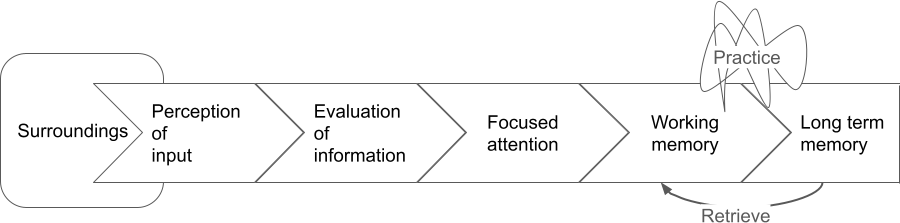
Imagine learning as if there is something in your surroundings (a book or a lecture, for instance) that you have not sensed nor processed yet. You need your senses to carry that information for you to process and learn from.
- If your nervous system is alert it perceives signals from the surroundings (and from your body).
- Your experienced nervous system automatically evaluates whether the signal is relevant information to you or is to be discarded.
If the information gets your attention because of relevance, you can process it:
- If the information is “itch” your task is “scratch” and by that bring yourself back to equilibrium.
- If the signals are texts or words in a lecture the tasks are not bodily actions, but cognitive ones.
You process the information by comparing the information to what you have stored in your long-term memory.
What if your nervours system is not alert? Do you miss important information and do you know if you do?
What if your nervous system makes poor judgements regarding relevans and discards too many or too few signals? What load does it put on your working memory?
What if your senses over- or underreacts to signals from your senses? Most of us know motion sickness when our vestibular sense overreacts. Can we be over- or understimulated by other senses?
Part three: Your neurotransmitters and self regulation. Feelings
To regulate itself back to equilibrium the nervous system uses the senses to feel. Those feelings are interpreted by the nervous system as emotions, to make you “do” something. If the information is “tired” your task is to go to sleep, “hungry” you must eat and so on, when the signals are from your body. If the signal is “danger” or “mating time” your nervous system makes your body gets ready for other tasks.
Your nervous system needs to be alert to catch information with your senses and your mind need to focus on the right information to learn.
Acetylcholine is a neurotransmitter that plays a role in memory, learning, attention and arousal (alertness).
Adrenaline and norepinephrine are responsible for your body’s “fight-or-flight response” to fear and stress.
Dopamine helps with focus, concentration, memory, sleep, mood and motivation and plays a role in your body’s reward system, including achieving heightened arousal (alertness) and learning.
GABA helps you concentrate.
Glutamate plays a key role in cognitive functions like thinking, learning and memory.
Glycine is involved in controlling hearing processing.
Histamine regulates body functions including wakefulness (alertness).
Fourth part is knowing the system: (Un-)spoken expectations and other ways of being
Understand what the educational system offers to find a way to accommodate your needs and meet your goals. YOUR goal is to study to become some kind of professional and have a rewarding career afterwards, right? Societies, industries and universities (all educational institutions) have made a pact: Universities educate the students. Not just for this job in that company, but for this kind of job in that industry or even in other industries. Educational institutions even educate students to become democratic citicents, informed consumers, and fulfilled persons.
Universities describe how they educate students with learning goals, learning outcomes, learning objectives.
Here is the European model of education in a Danish context:
Read the objectives and compare to the educational taxonomies for each objective (depending on the learning goals, one or both of the taxonomies is what you get graded after)

You are not alone:
“One size fits one” is how I regard most of the excellent advice on the internet, including my own! During all my years as a student, I have found that, metaphorically speaking, 60-80% of the strategies work for me 60-80% of the time. Sometimes, studying is a hyperfocussed bliss; other times, I need a break. For years!